
컨텐츠영역
- 글번호
- 5690
The Institute for Far Eastern Studies, Kyungnam University and the Korea-Japan Peace Forum Hold Joint Seminar
| Date | 2026-08-21 |
|---|---|
| type | News |

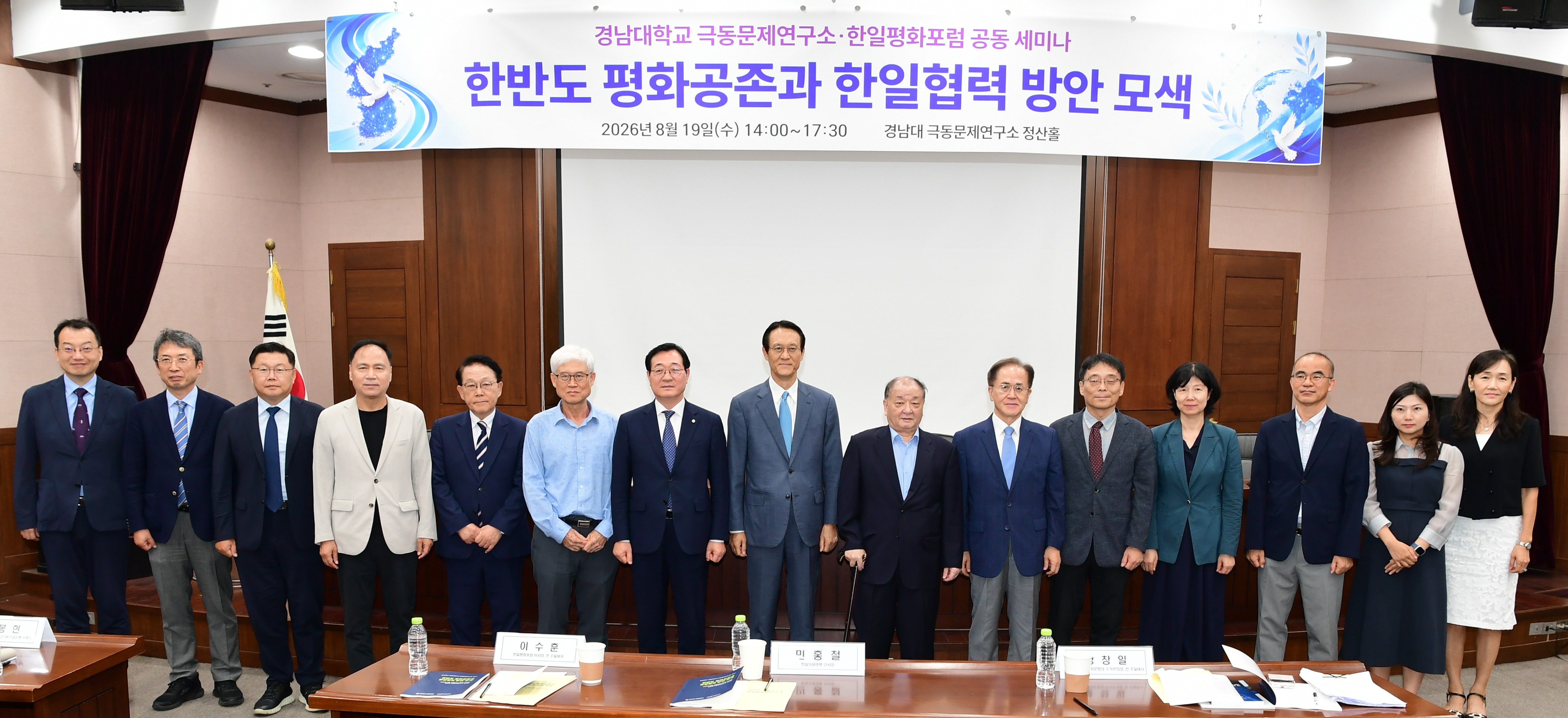
The Institute for Far Eastern Studies, Kyungnam University (Director Lee Kwan-Sei) held a seminar titled “Exploring Peaceful Coexistence on the Korean Peninsula and Ways to Promote Korea-Japan Cooperation” in collaboration with the Korea-Japan Peace Forum at 2:00 p.m. on Wednesday, August 19, in Jeongsan Hall of the Unification Building.
In his opening remarks, Lee Su-Hoon, Chairman of the Korea-Japan Peace Forum, emphasized the importance of peaceful coexistence between North and South Korea and the building of trust between Korea and Japan—as outlined in the speech commemorating the 81st anniversary of Liberation Day—and proposed a “New Korea-Japan Joint Declaration” (tentative title) that would carry forward and build upon the Kim Dae-jung–Obuchi Joint Declaration. In his welcome address, Director Lee Kwan-Sei stated that, amid the complex security environment in Northeast Asia, the transition from the armistice regime to a peace regime must be linked to Korea-Japan cooperation to ease tensions on the Korean Peninsula and improve North Korea-Japan relations. This was followed by congratulatory remarks from Kang Chang-il, Senior Vice Chairman of the National Unification Advisory Council; Min Hong-chul, Secretary-General of the Korea-Japan Parliamentarians’ League; and Kim Jina, Second Vice Minister of Foreign Affairs.
During Session 1, titled “Inter-Korean Relations: Peaceful Coexistence on the Korean Peninsula and the Transition to a Peaceful Structure,” Cho Yong-geun, a visiting professor at Kyungnam University, pointed out the possibility of accidental clashes resulting from North Korea’s measures to turn the Military Demarcation Line (MDL) into a border. He proposed restoring the direct military hotline between the two Koreas, resuming military talks, and proclaiming a “Declaration of Peaceful Coexistence on the Korean Peninsula” and an “MDL Peace Zone.” Cho Bong-hyun, former Deputy President of IBK Industrial Bank of Korea, proposed a plan to gradually expand inter-Korean exchange and cooperation from humanitarian and livelihood cooperation to tourism and industrial cooperation, as well as infrastructure cooperation in Northeast Asia—including railways, roads, and energy.
During Session 2, titled “Korea-Japan Relations: Ways for Korea-Japan Cooperation to Promote Peace on the Korean Peninsula,” Cho Seong-ryeol, a visiting professor at Kyungnam University, emphasized the need to expand security cooperation between Korea and Japan while stably managing issues such as historical disputes, Dokdo, and differences in threat perceptions. Lee Ki-tae, Director of the Center for Foreign Policy and Strategy at the Sejong Institute, proposed establishing a permanent communication channel between Korea and Japan in preparation for improved North Korea-Japan relations, as well as for Korea to play the role of a mediator and facilitator.
During the general discussion, participants discussed ways to prevent military clashes between North and South Korea, phased preparations for resuming exchanges and cooperation, the conditions for security cooperation between South Korea and Japan, and measures to improve relations between North Korea and Japan.
This seminar was organized to explore policy measures aimed at easing tensions between North and South Korea based on the vision for peaceful coexistence presented in the speech commemorating the 81st anniversary of Liberation Day, and to develop South Korea-Japan cooperation as a driving force for peace on the Korean Peninsula and improved North Korea-Japan relations.