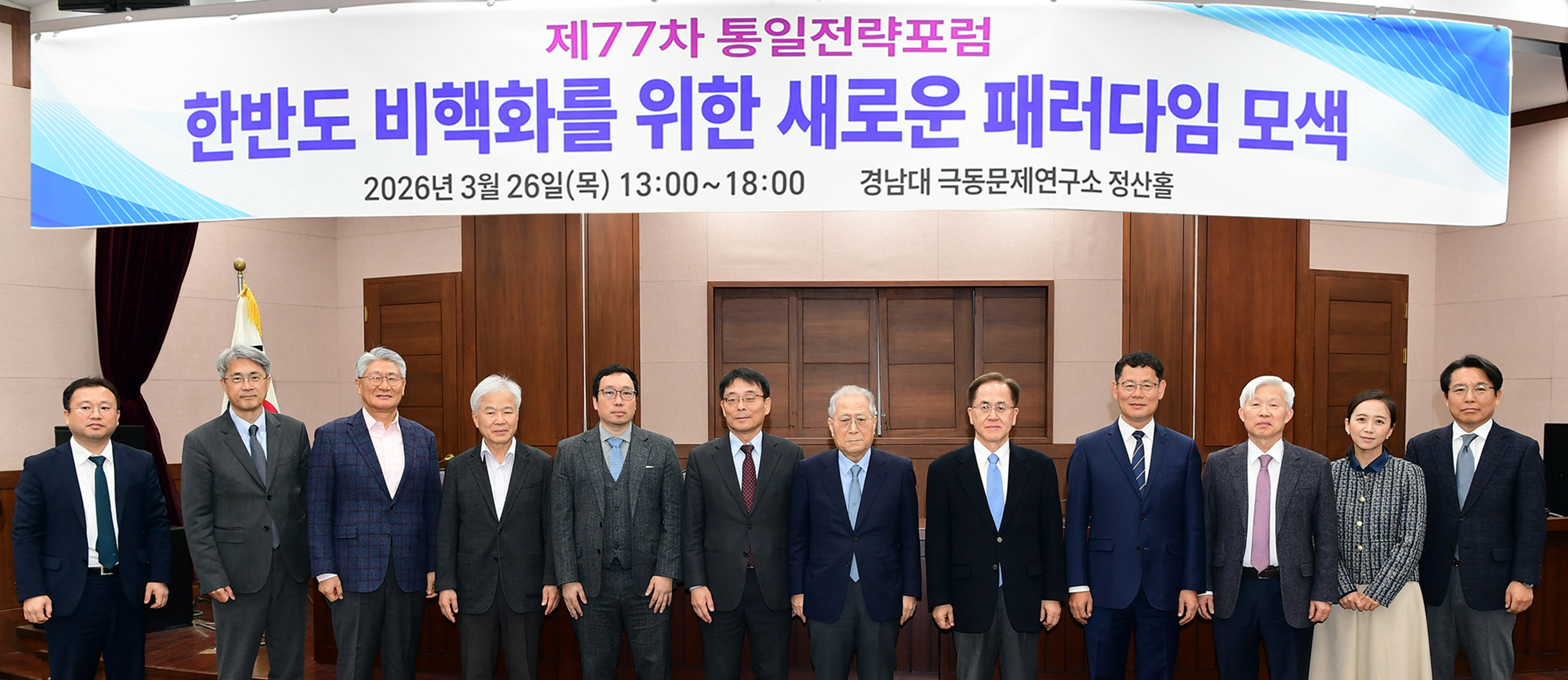
The Institute for Far Eastern Studies of Kyungnam University (Director Kwan-Sei Lee) hosted the “77th Unification Strategy Forum” on March 26 (Thu) at 1 p.m. in the Jeongsan Hall, under the theme of “Exploring a New Paradigm for Denuclearization on the Korean Peninsula”.
In his opening remarks, Director Kwan-Sei Lee noted that “the omission of the phrase ‘denuclearization of the Korean Peninsula‘ from key security documents such as the United States’ National Security Strategy (NSS) and China’s defense white paper reflects a serious erosion of established international principles.” He emphasized that “in response to North Korea’s emerging ‘Cold Peace’ posture, it is now imperative to move beyond legacy frameworks and develop clear-eyed, innovative approaches.”
■ Keynote Address: “A New Approach to a Nuclear-Free Korean Peninsula”
Former Minister of Unification Yeon-chul Kim, delivering the keynote address, argued that “denuclearization has largely disappeared from the discourse and that this reality must be acknowledged.” He also suggested that “while maintaining denuclearization as a long-term objective, there is an urgent need for a paradigm shift toward reducing nuclear risks in the near term through ‘operational arms control’, including the suspension of nuclear testing and related activities.” As a practical pathway, he proposed prioritizing the establishment of a peace regime in parallel with confidence-building measures in conventional forces and phased sanctions relief.
■ Session 1: “New Strategies for a Nuclear-Free and Peaceful Korean Peninsula”
Moderated by Director Kwan-Sei Lee, Session 1 featured Professor Seong-Ryoul Cho (Visiting Professor of Military Studies, Kyungnam University), who proposed a ‘a quid pro quo framework on hard security issues’, linking a North Korean nuclear freeze with a halt to the deployment of strategic assets. He also suggested the institutionalization of a ‘dual snapback’ mechanism, under which violations by North Korea would trigger the simultaneous reinstatement of sanctions and infrastructure restrictions by the United States, China, and Russia.
Professor Byong-chul Lee (IFES) introduced the concept of a ‘good divorce’ strategy, advocating for a managed inter-Korean relationship based on mutual non-interference. Research Fellow Seung-Hyeok Baek (Seoul National University Nuclear Energy Policy Center) proposed technical enforcement mechanisms, including a ‘kill-switch for offshore power plants’ that could immediately disable energy supply in the event of non-compliance.
Honorary Research Fellow Sang Hyun Lee (Sejong Institute) argued that, in response to the transactional approach of the Trump administration, South Korea should leverage economic incentives, such as increased imports of U.S. LNG and expanded defense cooperation, to prevent ‘Korea passing’, or South Korea’s national interests being sidelined throughout the course of engagement and negotiations between North Korea and the U.S. He further recommended codifying a bilateral 'no surprise’ principle to ensure that U.S. Forces Korea and joint military exercises are separated from the negotiating agenda on North Korea’s nuclear program. In addition, he underscored the need to strategically exploit potential gaps in North Korea-Russia alignment once the war in Ukraine comes to an end.
Head of the Korean Peninsula Security Research Division, Kyung-joo Jeon (Korea Institute for Defense Analyses) emphasized that, rather than rushing into U.S.–North Korea dialogue, South Korea should prioritize close pre-coordination with the United States to identify realistic negotiating agendas, including a nuclear freeze. Visiting Professor Kyu-duk Noh (Halla University) emphasized the urgent need for close prior coordination to ensure that issues related to the U.S.–ROK alliance are not put on the table in negotiations between North Korea and the United States, and called for measures to prevent any weakening of the alliance.
■ Session 2: “Strategic Options for Transforming Inter-Korean Relations”
Moderated by Professor Moo-Jin Yang (Chair Professor, UNKS), Session 2 opened with remarks by Vice President Yonghwan Choi (Institute for National Security Strategy), who argued that South Korea should break free from the ‘North Korea nuclear-first’ approach that is fixated on resolving the nuclear issue as a precondition, and instead focus on securing ‘strategic stability’, including the prevention of accidental clashes and arms control. In particular, he suggested preemptively establishing a minilateral cooperation framework involving neighboring countries such as China and Russia to indirectly draw North Korea into engagement, and called for building a social consensus around a new unification discourse based on peaceful coexistence that excludes unification by absorption.
Professor Sang Bum Kim (IFES) observed that North Korea has entered a phase of focusing on ‘how to use’ its nuclear capabilities, and argued that South Korea must accordingly redefine its own state role. Vice Dean Youngchul Chung (Graduate School of Public Policy, Sogang University) emphasized that North Korea’s ‘two-state theory’ represents a long-term strategic choice, and called for initiating a social debate on revising constitutional and legal frameworks to reflect this reality.
Professor Jeong-Chul Lee (Department of Political Science and International Relations, Seoul National University) proposed that South Korea take on an active ‘pacemaker’ role by facilitating a ’direct visit by former President Trump to Pyongyang or Wonsan’, thereby opening a pathway for renewed U.S.–North Korea dialogue. He also advocated a flexible stance toward a potential peace declaration among North Korea, China, and the United States, even in the absence of South Korea, and suggested practical alternatives such as indirect engagement through four major China-linked cooperation projects and local government-led projects aligned with North Korea’s ‘20×10 Regional Development Policy’.
In response, Visiting Chair Professor Byung-Jae Cho (IFES) recommended lowering the threshold for dialogue by reframing U.S.–North Korea engagement from ‘resolution’ to ‘risk management’, while ensuring institutional safeguards to prevent South Korea’s marginalization during mediation. Professor Kab-Woo Koo (UNKS) characterized U.S.–North Korea negotiations as fundamentally a ‘game of sovereign recognition’, and called for public deliberation on revising domestic legal frameworks that embody hostility toward North Korea in order to enable mutual recognition between the two Koreas.
Director Kwan-Sei Lee concluded by noting that “the forum served as a platform to generate strategic insights aimed at securing South Korea’s policy autonomy amid a complex crisis shaped by North Korea’s legal codification of its nuclear status and the transactional approach of the Trump administration.” He expressed hope that “the concept of a ‘multilateral, comprehensive security governance framework’ discussed at the forum would serve as a meaningful milestone in transitioning the Korean Peninsula from a zone of confrontation to an era of peaceful coexistence.”