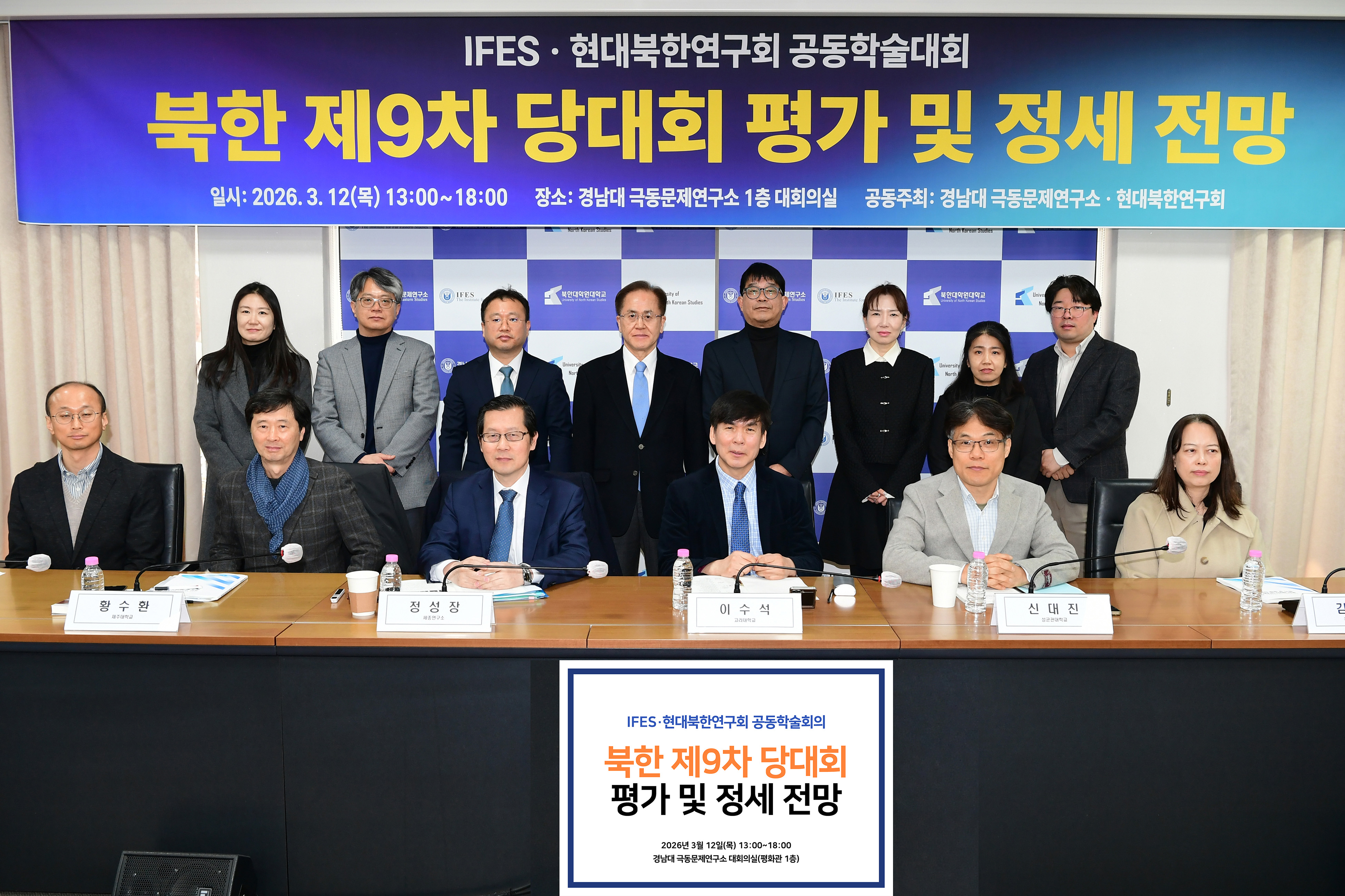
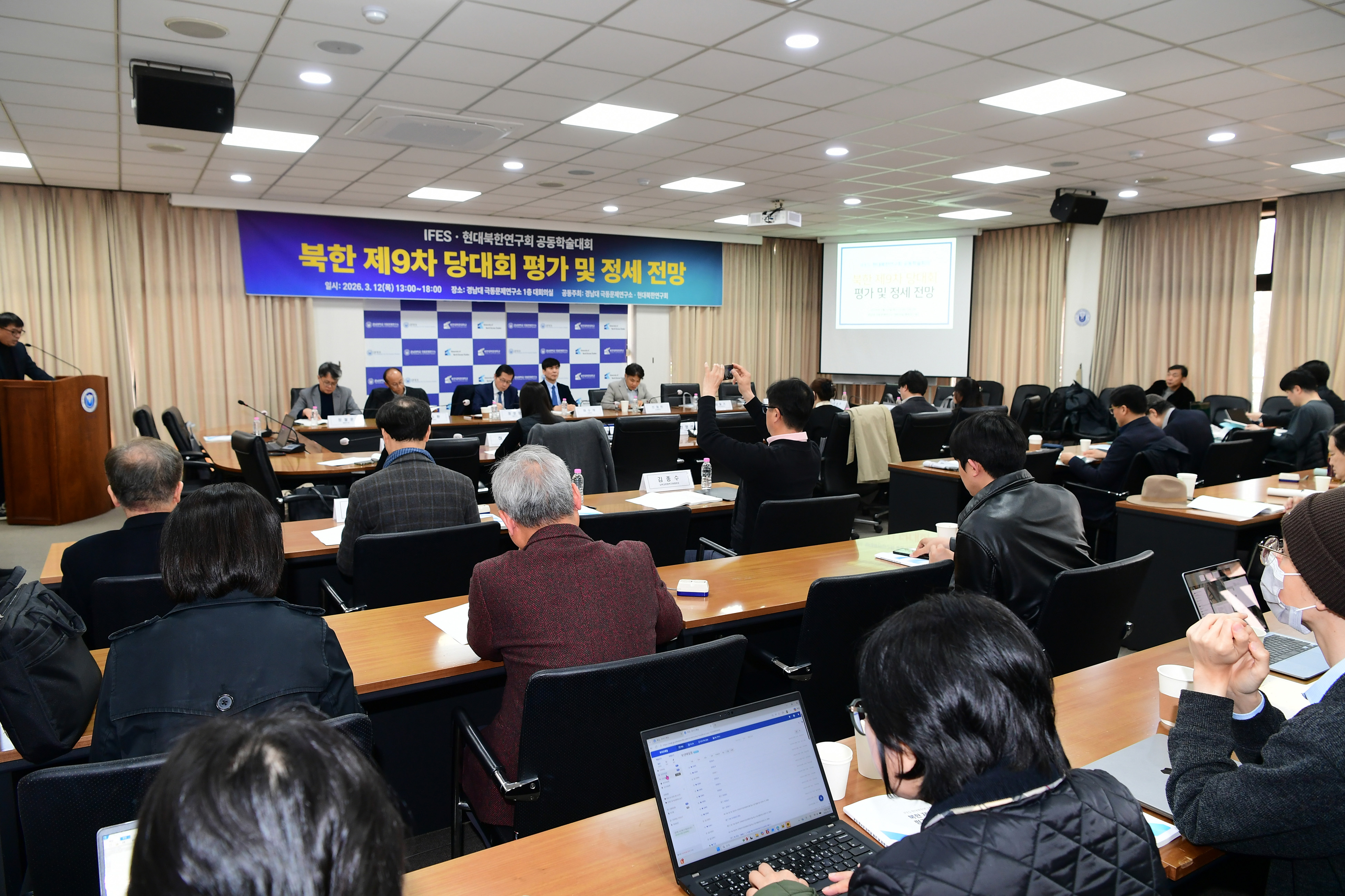
The Institute for Far Eastern Studies of Kyungnam University (Director Kwan-Sei Lee) hosted a joint academic conference with the Association of Contemporary North Korea Studies on March 12 (Thu) at 1 p.m. in the IFES Conference Room, Peace Hall, titled “Assessing the 9th Party Congress of North Korea and Outlook for Future Developments”. The conference was convened to provide a comprehensive, multidimensional analysis of the outcomes of North Korea’s recent 9th Party Congress and to present an outlook on North Korea’s future domestic and foreign policy directions, as well as broader developments on the Korean Peninsula. In particular, the discussions offered an in-depth assessment across seven key areas: politics; foreign and inter-Korean relations; military affairs; the economy; society and culture; forestry, land and environment; and education.
The conference brought together around 20 experts on the Korean Peninsula, including Director Kwan-Sei Lee, President Sang Bum Kim, Dr. Seong-Chang Cheong (Sejong Institute), and Dr. Young-sun Jeon (Konkuk University). The academic conference opened with welcoming remarks by President Sang Bum Kim of the Association of Contemporary North Korea Studies, followed by opening remarks from Director Kwan-Sei Lee and a congratulatory address by Jong-soo Kim, Chairman of the South-North Korea Exchanges and Cooperation Support Association.
The first session, chaired by Dr. Su-seok Lee (Korea University), focused on North Korea’s core strategic domains such as politics, diplomacy, and military affairs. Presenting on the political dimension, Dr. Seong-Chang Cheong (Sejong Institute) analyzed the sweeping turnover of power elites at the 9th Party Congress and the complete exit of the second-generation partisan cohort. He argued that these developments signal a fundamental restructuring of the power system and mark the full-fledged opening of the ‘Kim Jong Un 2.0’ era.
In foreign and inter-Korean affairs, Dr. Soo-Hwan Hwang (Jeju National University) analyzed that inter-Korean relations have become fixed as ‘two hostile states’ relations, completely subordinated to foreign affairs, and that North Korea has formally adopted a hard-line foreign policy based on the unwavering protection of its national interests and its nuclear capabilities.
For the military sector, Dr. Cheol-wun Jang (Korea Institute for National Unification) noted that North Korea’s ‘new five-year defense development plan’ is centered on the operational deployment and qualitative advancement of its nuclear capabilities. He also projected that initiatives to strengthen conventional forces which were left undisclosed at the Party Congress, will be pushed ahead gradually over the next five years. Designated discussions followed, which were delivered by Dr. Dae Jin Shin (Sungkyunkwan University), Dr. Il-Gi Kim (Institute for National Security Strategy), and Dr. Taekbin Kim (Korea National Defense University). A comprehensive and in-depth diagnosis of changes in North Korea's power structure and its positioning in foreign relations was conducted across all three areas.
The second session, chaired by Dr. Young-sun Jeon (Konkuk University), focused on North Korea’s domestic policies. Presenting on the economic sector, Dr. Il Han Kim (Dongguk University) highlighted that cabinet-centered economic system reforms are beginning to take hold. He noted that, under the guiding principle of the ‘simultaneous development of the economy, national defense, and culture’, North Korea is likely to prioritize tangible outcomes in key real-economy sectors such as agriculture, construction, and energy.
In the social and cultural sector, Dr. Seunghee Ha (Dongguk University) observed that North Korea’s governing narrative is shifting from a ‘leader-centric’ to a ‘state-centered’ framework. She assessed that this transition is accompanied by the strengthening of a dual-track governance strategy which is tightening control over external cultural influences while allowing greater flexibility in domestic cultural content.
In the forestry, land and environment sector, Dr. So-young Park (National Institute of Forest Science) noted that North Korea’s forest policy has moved beyond simple restoration and is increasingly integrated with broader land and regional development policies. She assessed that the country is transitioning toward a model of sustainable, multifunctional forest management.
Finally, in the education sector, Dr. Hyun Sook Um (National Institute for Peace, Unification and Democracy Education) explained that North Korea’s education policy reflects a form of ’partial modernization’, combining the cultivation of science and technology talent with continued ideological control. She noted that the system is increasingly geared toward developing practical human resources capable of supporting both economic growth and national defense.
This was followed by designated discussions from Dr. Eunju Choi (Sejong Institute), Dr. Hyung-Jong Lee (IFES), Dr. Sam-eon Oh (Dongguk University), and Dr. Seung-Ju Cha of Gongju National University of Education. Across four thematic areas, the session offered a detailed assessment of broader transformations within North Korean society.
The conference concluded with a roundtable discussion chaired by Director Kwan-Sei Lee, and the participation of Dr. Dae-geun Lee (Woosuk University), Dr. Il Han Kim (Dongguk University), Dr. Young-sun Jeon (Konkuk University), and Dr. Sang-sook Lee (Korea National Diplomatic Academy). The panel offered an overall assessment of the 9th Party Congress and engaged in a comprehensive discussion on the future trajectory of the developments on the Korean Peninsula.
Director Kwan-Sei Lee emphasized that “The conference comes at a particularly critical moment, when North Korea’s strategic choices are poised to have an unprecedented impact on the Korean Peninsula.” He also added that “The insights shared by participating experts served as an important milestone in advancing an objective understanding of internal developments in North Korea and I hope that they will be helpful in shaping effective government policies on North Korea and unification.”