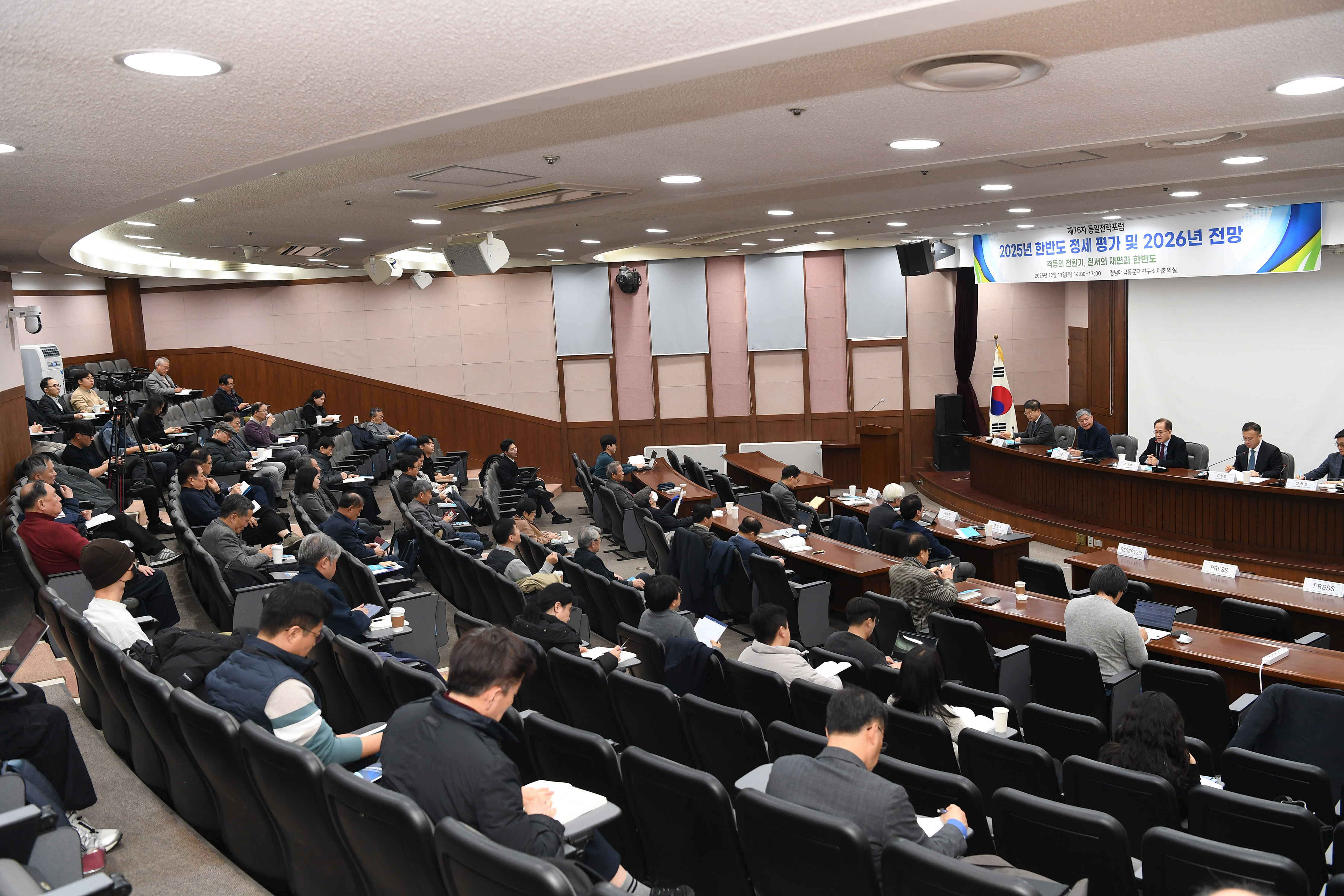
The Institute for Far Eastern Studies (Director Kwan-Sei Lee) held the 76th Unification Strategy Forum under the theme “A Turbulent Transition: Reordering the International Order and the Korean Peninsula” at 2:00 p.m. on Thursday, December 11, at Jeongsan Hall, Unification Building. The forum was structured around four sub-themes, featuring presentations and discussions that focused on changes in the international order and changes and prospects for the situation on the Korean Peninsula.
The first session—The “Two States Framing” and Unification Discourse—featured a presentation by Gee-dong Lee, Senior Research Fellow at the Korea Institute for National Security Strategy, with a discussion by Sang Bum Kim, Professor at IFES.
Lee argued that Kim Jong Un has raised the threshold for any progress in inter-Korean relations by proposing three conditions related to “hostility”: the abandonment of unification by absorption, the suspension of ROK–U.S. combined military exercises and strategic asset deployments, and the avoidance of references to denuclearization. He warned that defining a “sphere of sovereignty” could escalate into border disputes in the West Sea (NLL) and proposed discussions on institutionalizing peaceful coexistence. In response, Kim contended that the concept of “two hostile states at war” functions as a power strategy that eliminates the middle ground for dialogue and compromise, thereby entrenching confrontation. He emphasized that South Korea needs to pursue proactive crisis management based on national interests, enhance its leverage with China, and reframe the unification discourse around interests.
The second session—Reconfiguration of U.S.–China Strategic Competition and Supply Chain Shifts—featured a presentation by Han-Jin Park, Visiting Professor at the Graduate School of International and Area Studies, Hankuk University of Foreign Studies, with discussion by Pyung-Seob Yang, Visiting Research Fellow at the Korea Institute for International Economic Policy. Park characterized U.S.-China competition not as a trade conflict but as the institutionalization of “mutual deterrence” through technology, standards, and supply chains. He noted that single point of failure (SPF) in semiconductor and AI supply chains such as EDA, EUV, CoWoS, and HBM have evolved into security infrastructure risks. Emphasizing “design over forecasting,” he proposed a strategy based on continuous management through a 3×3 scenario framework and 15 transition indicators (early-warning signals), alongside a “full-scenario” strategic portfolio that coordinates industry, trade, technology, diplomacy, and security. Yang assessed that amid systemic friction, reality is trending toward repeated “small deals” and the entrenchment of strategic decoupling in sensitive technology sectors. As policy responses, he emphasized institutionalizing Korea’s decisive leverage through a shift toward a “U.S.-anchored security posture and a globally diversified economic strategy,” red/yellow/green box-based cooperation management, and upgrades to free trade agreements.
The third session—Restoration of North Korea-China Relations and North Korea–China–Russia Alignment—included a presentation by Jin-ho Doo, Director of the Eurasia Research Center at the Korea Research Institute for National Strategy, followed by discussion by Sangsook Lee, Professor at the Korea National Diplomatic Academy. Doo evaluated Kim Jong Un’s attendance at China’s Victory Day parade on September 3, 2025 as a signal of the restoration of North Korea-China relations since 2019, but cautioned against viewing this as evidence of the institutionalization of a trilateral alliance among North Korea, China, and Russia. He described the relationship as a “loose alignment” shaped by identity, institutions, and leadership, with each country acting according to its own interests. North Korea seeks negotiating leverage, China aims to counterbalance Russia-centric alignment, and Russia seeks expanded diplomatic space. Lee largely concurred but stressed the need to further consider economic cooperation factors, differences in threat perception, potential conflicts between North Korea-China and North Korea–Russia treaties, and the limited scope of North Korea-China security cooperation. She also cautioned against hastily interpreting the absence of denuclearization references as recognition of North Korea’s nuclear-armed status.
The fourth session—The Nuclear Issue on the Korean Peninsula in the Era of Trump 2.0—featured a presentation by Sang-Hyun Lee, Senior Research Fellow at the Sejong Institute, with discussion by Jaewook Chung, Professor at IFES. Lee characterized Trump 2.0 as a regression toward 19th-century-style great power politics and argued that, in a post-hegemonic environment where the North Korean nuclear issue is no longer a top U.S. priority, South Korea’s proactive deterrence and engagement are increasingly important. He suggested that the END initiative may ultimately converge on a pragmatic strategy focused on nuclear threat management and gradual denuclearization. Jung assessed approval of nuclear-powered submarines as a political signal but highlighted multiple variables affecting feasibility, including the decade-long development timeline, potential changes in government, revision of the nuclear cooperation agreement, and shipbuilding infrastructure. He emphasized that rather than the possession itself, the key criterion should be whether such capabilities substantively contribute to strategic stability on the Korean Peninsula and in East Asia, given the risk of escalating regional tensions.
In his concluding remarks, Kwan-Sei Lee, Director of IFES, stated that the forum provided an opportunity to build consensus around a comprehensive assessment of the direction and implications of changes surrounding the Korean Peninsula amid the accelerating reorganization of the international order. He added that the multifaceted discussion of key issues—including inter-Korean relations and unification discourse, U.S.–China strategic competition and supply chain shifts, the restoration of North Korea–China relations and trilateral cooperation with Russia, and nuclear issues in the era of Trump 2.0—offered meaningful policy insights into the formulation of the government’s future strategies on North Korea and foreign and security affairs.